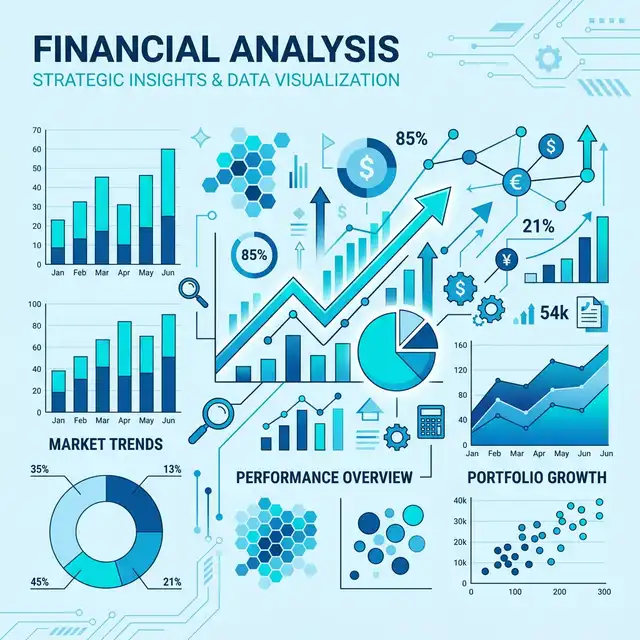
What is Financial Analysis and Why Does it Matter?
In the expansive world of business and investment, financial analysis is an indispensable evaluation tool.
Financial analysts analyze data from balance sheets, income statements, and cash flows to extract key ratios. This helps senior management make strategic decisions like buying vs leasing or expanding production.
Primary Objectives of Effective Financial Analysis
Financial analysis aims to reach facts about:
- 1. Profitability: Tracking the company's ability to generate income and maintain growth.
- 2. Solvency: Measuring financial strength in paying long-term debts and facing recessions.
- 3. Liquidity: Ensuring sufficient cash flow to cover immediate expenses.
- 4. Stability: Determining the ability to continue without heavy losses.
Core Methods of Financial Analysis
1. Vertical Analysis
Also called common-size analysis; it converts financial figures into percentages based on a base figure (like total sales). It provides an immediate look at cost structures.
2. Horizontal Analysis
Aims to measure growth by comparing data over several consecutive years. It's vital for identifying "financial trends".
3. Ratio Analysis
The most famous method; it creates mathematical relationships between balance sheet and income statement items to reflect specific performance aspects.
The Most Critical Financial Ratios
Accounting ratios are divided into specialized groups:
- Liquidity Ratios: Measures ability to meet short-term debt. Example: Current Ratio.
- Profitability Ratios: Understanding asset capacity to generate profit. Example: ROA, Net Margin.
- Debt Ratios: Knowing the percentage of funding through debt. Example: Debt-to-Equity.
- Activity Ratios: Reveal efficiency in utilizing assets. Example: Inventory Turnover.
- Market Ratios: Evaluate stock performance. Example: P/E Ratio.
Financial Analysis in Action: Arab Market Examples
Saudi Market (Tadawul)
For giants like Aramco, analysis determines the ability of cash flows to support dividend distributions compared to global energy peers.
UAE Market
In banking entities like ENBD, horizontal analysis is used to track profit growth rates and liquidity ratios amidst intense competition.
Egyptian Market
For companies like Elsewedy Electric, ratio analysis helps understand leverage levels and asset turnover in the infrastructure sector.
How to Conduct an Accurate Analysis in 6 Steps
- Obtain Reliable Data: Extract files (Income, Balance Sheet, Cash Flow) following GAAP or IFRS.
- Use Advanced Tools: Utilize professional Excel modeling or ERP systems to ensure calculation safety.
- Apply Comprehensive Indicators: Combine vertical and horizontal analysis to map growth trends.
- Read Results and Analyze Gaps: Search for anomalies (like shrinking margins or sudden cost spikes).
- Benchmarking: Compare your ratios with industry averages. Analysis without context loses value.
- Provide Strategic Summary: Write a report summarizing challenges and proposing actionable solutions.
Modern Technology in Enhancing Analysis Outputs
Manual reporting is a thing of the past. Modern software shortens analysis efforts:
- Instant Automated Reports: Providing unified reports at the click of a button.
- AI Forecasting: Studying the past to predict future cash flow trends.
- Automation: Linking administration, logistics, and accounting systems.
FAQs on Financial Analysis Tools
What is the biggest challenge?
The fact that past performance doesn't necessarily guarantee future performance in volatile economies.
Difference between horizontal and vertical analysis?
Vertical shows numbers as a percentage of a base in one year, horizontal cares about the trend across consecutive periods.
Can we ignore non-financial data?
No, combining non-financial data like market share and customer satisfaction completes the picture.
Seeking precise financial analysis to elevate your business?
I offer customized financial analysis and dashboard modeling to transform your raw data into explosive growth strategies.
Book a Financial Consultation